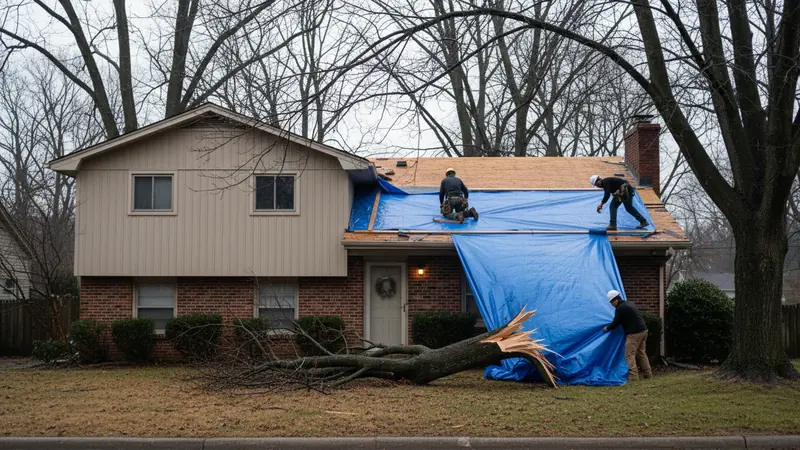
What the county charges. What needs inspection. Why fixing storm damage can mean more than replacing what's wet or broken.
We've dated every figure when we gathered it. You'll find source dates beside the requirements they affect. We've also said where we could not settle a question.
Do you actually need a permit?
Start by saying what broke: roof covering, roof framing, wall, deck boards, railing, wiring, or equipment. “Storm damage” alone does not tell the county what work it needs to review.
Howard County's residential application handout gives replacing damaged roof trusses as an example. That applies even when you're restoring the building to its original condition. Putting it back as it was does not, by itself, mean you're exempt from a permit. The handout also gives removing and reinstalling solar panels for reroofing as a permit application example. Mention any existing solar array when you describe your roof repairs.
DILP draws a useful line for decks. Replacing decking boards without replacing the supporting structure counts as ordinary repair. You do not need a permit for that. You do need one to replace handrails or guardrails, even with the same product.
We could not verify the roof exemption. The introduced building-code bill exempts roof-covering replacement and some other exterior repairs. The Council later passed an amended bill. We could not retrieve its final signed PDF during this research. We therefore cannot confirm the roof-sheathing allowance. Nor can we say you can always reroof without a permit. Ask DILP at 410-313-2455, option 4. Describe the covering as well as any damaged material underneath. We have not treated the introduced text as final law.
Source: Howard County DILP, Residential Miscellaneous & Addition Online Building Handout, dated 2025-11-05; DILP frequently asked questions, undated; Howard County Council, CB24-2025 legislative record, effective 2025-09-07, and introduced text, not relied upon as the enacted exemption schedule. Gathered 2026-09-22.
What the permit costs
The county's FY27 schedule, effective 1 July 2026, covers alterations and repairs to attached and detached single-family dwellings. These charges pay for your building permit. They are not the price of repairing your house.
| Single-family alteration or repair | Published charge |
|---|---|
| Nonrefundable filing fee | $25 |
| Single/small room or area, 200 square feet or less | $50 |
| More than single floor or area, over 200 square feet | $100 |
| Technology fee on permits | 10% |
Check how the county classifies your work and calculates the fee. The larger-work entry mixes a floor description with an area threshold. We read the square footage in brackets as the dividing point. We could not settle how DILP measures a roof repair. The administrative schedule bases the technology charge on the permit or license fee. It does not expressly say whether the separate filing fee counts. These are the published charges, so we have not added them into a total. Confirm the classification with DILP at 410-313-2455, option 4. Check the fee calculation too.
You may face extra administrative charges if hidden damage changes the job:
| Administrative item | Published charge |
|---|---|
| Residential/trade application revision after the first; any revision after approval for issuance or issuance | $50 |
| Reinspection after 2 failures of the same inspection | $100 |
| Reinspection after 3 failures | $125 |
| Reinspection after 4 or more failures | $175 |
| Work commenced without a required permit | $100 |
Electrical, plumbing, or mechanical repairs may need permits in those categories too. Do not read these charges as a combined fee for every trade. Check an apartment building's classification before using the single-family schedule.
Source: Howard County DILP, FY27 Building Permit Fee Schedule, page 1, and FY27 Administration, pages 1–2; Council Resolution 83-2026, effective 2026-07-01. Gathered 2026-09-22.
What goes into the application, and how long it takes
Apply for your residential building permit electronically through Howard County's Citizen Access. The residential checklist asks you to describe the work accurately. Supply drawings or specifications suited to your project. Include contractor information. Add license documents where required. Include condo or HOA approval where required too. Some projects also need a plot plan. You may also need to submit construction drawings through ProjectDox.
Start your repair scope by separating out the parts of the house you're repairing. Identify the affected level. Say which framing is involved. Describe any changes to openings. Include any equipment work. Photographs can help explain the damage. They do not give a reviewer construction details showing how you'll rebuild a damaged connection.
We could not verify a Howard County storm-repair permit turnaround from the primary sources we reviewed. We could not verify an emergency review deadline either. We cannot promise a number of days. The checklist lists possible reviews for zoning, floodplain compliance, building codes, and well or septic conditions. Which ones apply depends on your property and the work.
You can check your application's review status through the county's system. It shows which agency has yet to approve it. Before relying on a contractor's proposed start date, ask where the permit stands. Issued? Awaiting review? Still being prepared? Those are very different stages.
Source: Howard County DILP, Residential Miscellaneous and Addition Building Permit Checklist, dated 2023-12-18; Plan Review Division, undated; Automated Inspection Request and Permit Information System, April 2025 posting. No storm-specific issuance deadline verified. Gathered 2026-09-22.
The floodplain question can change the whole repair
Howard County's substantial-damage rule applies to buildings in the Special Flood Hazard Area. Repairs costing 50% or more of the building's value trigger it. You must then bring the building up to county and National Flood Insurance Program standards. Damage from any cause counts, including wind. Leave land value and exterior improvements out of the building-value comparison.
Check the floodplain even if a tree hit your roof but your basement stayed dry. A property price that includes the land cannot tell you whether you've reached the threshold.
The county also requires applicable floodplain certificates when you repair a substantially damaged building in or adjacent to the Special Flood Hazard Area. Which documents you need depends on the project. They can include an Elevation Certificate, engineered flood-opening certification, a No-Rise Certificate, or a nonconversion agreement. The county says its rules for adjacent development go further than the usual regulatory standard.
“Adjacent” is not a measured buffer in this guidance. We read this as a decision the county needs to make for each property. We could not find a stated setback. The guidance does not say every house needs every listed certificate. Ask DILP which documents you need. For flood-risk questions, you can contact the Stormwater Management Division at 410-313-6444.
Howard County's flood guidance distinguishes preliminary mapping from effective mapping. Use the county's flood-map viewer. Ask which information governs your application. A boundary on an old insurance document is not enough to settle a construction review.
Source: Howard County, Flood Protection, “Substantial Improvements & Substantial Damage” and mapping guidance; Stormwater Management Division, Regulations & Permits, “Submission of Floodplain Construction Certificates.” Guidance pages undated; no effective date stated for these summaries. Gathered 2026-09-22.
The inspections
A broken window, a rebuilt roof, and a flooded basement will not all need the same inspections. The county's published building inspection codes include:
- 209 — Frame
- 211 — Insulation
- 221 — Wall Brace Sheathing
- 205 — Final Building
Ask which stages apply before you cover up the work. These are available inspection types. Your storm repair may not need all of them. Electrical and other trades have their own inspection lists.
Once your permit is issued, you can request inspections for the next day or up to seven working days ahead. Call 410-313-3800, or text “Schedule” to 888-297-9841. Follow the prompts. You can reach the building/fire inspection office at 410-313-1810.
For a two-hour arrival window, call 410-313-1823 between 7:30 and 8:30 a.m. on the scheduled morning. You can get the results the day the inspection is completed. Being able to request an inspection does not guarantee when your storm repair will be finished.
Source: Howard County DILP, Automated Inspection Request and Permit Information System and Inspection Scheduling Instructions, April 2025 posting; first-sheet footer dated 2024-12-27. Gathered 2026-09-22.
What the inspector is actually going to check
For structural roof repairs, Howard County's checklist tells inspectors to compare your rafters with the approved design. They check size, span, lumber species, grade, and spacing. They also check bearing, connections, and bracing. Have the approved plans, truss drawings, and manufacturer information ready for the relevant inspection.
A damaged truss is not an invitation to improvise a splice. The checklist requires a registered design professional's approval before anyone cuts, drills, notches, splices, or otherwise alters a roof-truss member. Ask for the repair detail. An assurance that extra lumber will make it stronger is not enough.
The final-building checklist covers water problems too. Inspectors check that drainage takes water away from the building. They check moisture protection at caulking and flashing. The basement must be dry. Insulation must be finished. Required trade approvals must be in place. Replacing the visible ceiling stain may still leave important work unfinished.
The checklist gives general guidance. It is undated. For a limited repair, what applies depends on your approved scope and the current code. It does not mean every older house needs every new-construction feature before a small repair can pass.
Source: Howard County DILP, Inspection Requirements, residential roof framing and final-building sections; undated, no effective date stated. Gathered 2026-09-22.
Which code your job is held to
Howard County lists the 2024 International Residential, Building, Mechanical, and Energy Conservation Codes with county amendments, effective 7 September 2025. Its electrical listing is the 2023 National Electrical Code with local amendments, effective 3 June 2024. Ask for the applicable code in your proposal. Get the repair scope written down too. A promise to match the old work is not enough.
If you're rebuilding a roof, another local document matters. DILP's 18 September 2025 snow-load policy applies to projects submitted after 6 September 2025. They must follow the current code snow-load provisions and ASCE 7-22. Designers must use whichever is more restrictive: that standard's values or the locally adopted 40 psf value. For residential additions, garages, and enclosed structures, it allows 50 psf ground snow load instead of the ASCE standard. For screened or open residential porches, it allows 40 psf.
These are design rules, not a test of what your roof can hold. The policy does not expressly say whether a partial storm repair qualifies for its residential alternatives. We have not assumed it does. It also appears to have a typo in the bill number. The county's Adopted Codes page identifies the adoption as CB24-2025. Confirm which design rules apply to your repair through DILP's Plan Review Division.
Source: Howard County DILP, Adopted Codes, effective dates as above; Ground Snow Load Requirements for 2024 International Building Code, issued and effective 2025-09-18. Gathered 2026-09-22.
What goes wrong in Howard County houses
The strongest local evidence we reviewed concerns how buildings, roads, and stream channels interact in Ellicott City. It cannot tell us which failures are most common across the county: shingles, siding, or sump pumps. We cannot give you percentages for those.
The county's case study of the 30 July 2016 flood was prepared for its Office of Emergency Management. It records foundation damage near Frederick Road. It describes basement and first-floor flooding from both roads and creeks. It also records stacked-stone flood walls failing. Some buildings overhang or bridge the creek. Damage to their supports can turn a clean-up into a structural repair.
The report draws on property interviews, photographs, and county records. It describes that event in the study area. It does not describe every Ellicott City house. Nor does it tell you each building's condition today. Our practical reading: find out which way the water came in. Check supporting walls before deciding what to replace indoors. Water coming from the road and creek needs a different investigation from rain entering through a damaged roof.
The county's historical flood-mitigation grant notice names affected communities beyond historic Main Street. They include Valley Mede, Chatham, Dunloggin, and areas off Frederick Road, Old Columbia Pike, and New Cut Road. It lists flood doors, shielding, drainage work, and moving equipment as possible ways to protect a property. That was a past programme. The notice does not mean a grant is available today.
Write down what failed in your repair scope. Record where water entered too. Ask for a drainage proposal to explain which water route it addresses. Ask for a roof proposal to separate covering damage from damage to the supporting structure. A neighbourhood name or a stain cannot tell you that by itself.
Source: Howard County Office of Emergency Management, Case Study: 2016 Ellicott City Flood Event, prepared by Smith Planning and Design, dated 2017-04-15, particularly the address-zone narratives; Howard County, Application Deadline Approaching for Flood Mitigation Assistance Grants, published 2019-03-19, historical program notice. Gathered 2026-09-22.
Historic houses have another approval question
Is your property in the Ellicott City or Lawyers Hill local historic district? Check preservation requirements before ordering replacement exterior materials. The county publishes district maps. It also publishes separate design guidelines. Exterior changes can need a Certificate of Approval. An exemption from a building permit does not settle that question.
The Historic Preservation Commission also has a process for minor alterations. Its website says these applications are posted for five days. Objections could send your application to a Commission meeting. There is no fee for HPC application submissions, according to the Commission's current notice.
In an emergency, the county directs you to preservation staff at 410-313-2350 or preservation@howardcountymd.gov. Describe the urgent protective work separately from any permanent change in materials or appearance. The published guidance does not promise a decision within a stated number of hours. We cannot give you a deadline.
Source: Howard County Department of Planning and Zoning, Historic Planning and Historic Preservation Commission, minor-alteration, fee, and emergency-contact guidance; undated guidance, current meeting information for 2026. Gathered 2026-09-22.
Who is allowed to do the work, and what the quote should contain
For covered home-improvement work, the contractor signing the agreement with you must hold a Maryland Home Improvement Commission license. The MHIC category covers residential repair and replacement. It has exclusions, including commonly owned condominium areas. Check the licensing rules for a condo roof project separately. Do not assume the rules for an individual unit apply.
Maryland requires a written, signed home-improvement contract. It must describe the work and materials. It must identify the contractor, including their license number. It must give approximate starting and substantial-completion dates. The deposit cannot exceed one-third of the contract price. The contractor cannot accept payment before signing. You can check license and complaint questions with MHIC at 410-230-6231.
Spell out your storm repair scope: temporary protection, demolition, structural repairs, exterior weather protection, interior replacement, and permit responsibilities. Settle how newly exposed damage will be priced. Agree how you'll approve that work. This helps you compare proposals that put different work under the same “storm restoration” heading.
We could not find a county-specific installed price for storm damage repair in the primary sources we reviewed. We could not find an hourly billing rate either. We cannot give you an average repair price.
A contractor can estimate repairs. They can explain that estimate to your insurer. An MHIC license alone does not let them negotiate your insurance claim as a public adjuster. Maryland's Insurance Administration warns that required code upgrades can add costs. Whether those costs are covered depends on your policy and any applicable endorsement. Keep the construction estimate separate from the coverage decision.
Source: Maryland Department of Labor, Maryland Home Improvement Commission, scope and public-adjuster guidance, and Maryland Home Improvement Contracts; Maryland General Assembly, Business Regulation §8-617; Maryland Insurance Administration, Need to Make Repairs?. Current guidance/statute pages, no effective date stated on the cited pages for these provisions. Gathered 2026-09-22.
The short version
Define the repair before pricing it. Check whether it affects framing, utilities, a floodplain, or a historic exterior. Put the applicable permit requirements in your written scope. Include the inspection requirements. Settle who handles revisions if opening the building reveals more damage. Keep approved structural details with your job records. Keep inspection results there too. You can verify the county's permit charges. Your full repair price depends on the actual damage and the scope you've written down.
Source: Howard County DILP, Resources & Fees and Inspection Requirements; Maryland Department of Labor, Maryland Home Improvement Contracts. Summary of the dated sources above. Gathered 2026-09-22.