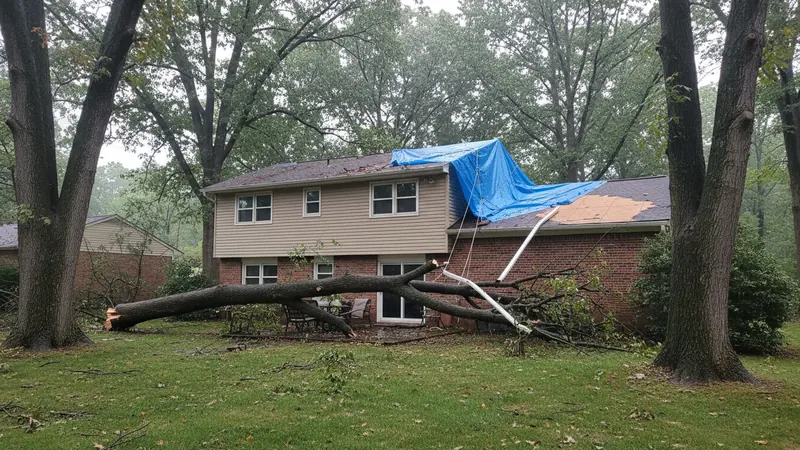
When a tree hits your house, start with who removes it. Work out what needs repairing. Check what insurance may pay. Settle where the broken tree goes.
Start with the house, the wires, and the road
A tree across your roof leaves several jobs to sort out. Someone must remove it. Someone must assess the house. Someone must make repairs. Someone must keep rain out of the exposed rooms. Ask who takes over at each stage. The tree crew finishing does not mean your house is safe to occupy.
If the tree brought down a power line, leave the area. Call 911, even if the line is not sparking. Howard County's storm guidance is explicit about this. Tell the tree crew about wires before anyone starts work.
The county's Tree Division clears fallen limbs from county roads. It generally does not remove plant material from private property. Do not expect the road crew to lift a trunk from your roof. Report an urgently blocked road by phone. Do not use email or SeeClickFix: the county warns that online reports may get a delayed response. During regular operating hours, call Highways at 410-313-7450. After hours, the county's tree guidance says to call police at 410-313-2200 about blocked roads.
Source: Howard County, Government Begins Preparations Ahead of January 24th–26th Winter Storm, published 2026-01-23, event advisory with no separate effective date; Bureau of Highways, Tree Maintenance, undated guidance, effective date not stated. Gathered 2026-09-23.
Put the tree work in its own written scope
Maryland DNR licenses tree experts. You can look them up in its searchable licence directory. Check the person responsible for your tree work. Check your home-improvement contractor's credentials too, as explained on the county storm-damage page. Ask the tree business for current proof of insurance before it works over your house.
DNR's rules require the licensee and business names in your written contract. It must describe the work. It must give expected work dates. It must state how much you will pay. It must say how you will pay. Both parties must sign any changes. Both must date them. For your job, “remove fallen tree” leaves too much unclear. Check what the price covers. Lifting it from the building. Cutting it on the ground. Hauling it away. Settle what happens to the stump.
Sort out access before equipment arrives. DNR says a licensed tree expert needs your neighbour's written permission to use their private property for access or work. If the crew plans to cross your neighbour's drive or garden, settle who gets that permission. Ask how the crew will protect surfaces along its route. Ask who deals with any damage the work causes.
Source: Maryland Department of Natural Resources, Licensed Tree Experts, licensing and published professional-conduct requirements, and Licensed Tree Experts Search; undated guidance, effective dates not stated. Gathered 2026-09-23.
Scope the impact beyond the hole in the roof
Once professionals can safely examine the damage, ask them to list the broken parts in your repair quote. Ask how they will repair each part. “Patch roof” does not tell you enough. Did the tree damage just the covering? Did it also damage the sheathing, rafters, trusses, or supporting wall? Ask your contractor to mark what needs opening up for inspection. Ask what remains uncertain until then.
Howard County's framing checklist covers more than the visible roof surface. It checks roof bearing and bracing. It checks wall studs and top plates. It checks the connections shown on approved plans. Does your repair cover the supports around the impact? Does it cover the connections too? Check beyond the broken member itself. You can find the truss-design approval rule on the county page. Ask who will supply any required repair detail. Get that written into the quote.
DILP handles the building permit, as explained on the county page. It also handles any inspections that apply. Settle who will arrange those checks before anyone covers up the repaired framing. Ask your contractor which supports are temporary. Ask what the finished repair involves. Ask how newly exposed damage would change the work. Put these questions to the responsible professionals. Do not enter the damaged attic yourself.
Source: Howard County DILP, Inspection Requirements, roof- and wall-framing checklists; undated, effective date not stated. The scope questions apply those published checks to a tree-impact repair. Gathered 2026-09-23.
Separate repair costs from what insurance pays
We found no Howard County-specific prices for lifting a tree off a house in the primary sources we reviewed. We found none for crane hire or tree-impact repairs either. The permit charges discussed on the county page do not tell you what building work costs. Ask for separate prices: tree work, temporary protection, structural repairs, roof and wall finishes, interior repairs, and hauling debris. Before you authorise extra work, get the quote to explain how it will be priced.
Maryland Insurance Administration guidance distinguishes removing a tree from a covered damaged structure from hauling it off your property afterwards. Ask your insurer how your policy treats each part. Ask your contractor to list those tasks separately on the invoice. Your policy's debris allowance is not a local contractor rate. It is not a promise to pay the whole bill.
If the tree grew next door, report the damage to your own insurer. The Administration says many policies cover a tree striking an insured structure even if it belongs to a neighbour. If your neighbour knew the tree was dead, your insurer may seek reimbursement. Keep relevant photographs and earlier correspondence. Do not assume your neighbour will pay just because the trunk crossed the boundary.
Source: Maryland Insurance Administration, Weather Related Damage, “Downed Trees,” and What to do if a tree falls on your property; undated consumer guidance, effective dates not stated. Coverage depends on the policy; no county repair-price schedule verified. Gathered 2026-09-23.
Preserve evidence while the house is protected
Photograph the tree against the building from a safe place. Keep the crew's photographs of areas you cannot safely see. Record what the crew removes. Keep receipts for urgent work. Maryland's Insurance Administration advises you to document the damage. It says to make repairs needed to prevent further damage before the adjuster inspects. Speak to your insurer before permanent repairs, as the Administration advises. Get their approval first.
Settle who will cover the opening after the tree is removed. Agree when they will do it. Describe the emergency work clearly in your paperwork. Spell out the permanent repair separately. Agreeing to urgent work should not leave you unsure what comes later.
If you cannot stay in your house, ask about additional living expenses under your policy. Keep receipts. Cover depends on the covered loss and your policy terms. Settle which finishes the repair covers before you order materials. The Administration warns that a partly damaged roof may get only a partial repair. Whether insurance covers mismatched shingles or siding depends on your policy wording. A quote to replace the whole roof does not establish what your insurer owes.
Source: Maryland Insurance Administration, Automobile and Homeowners Post Disaster Claim FAQs, homeowner repairs, living expenses, and roof/siding guidance; undated, effective date not stated. Gathered 2026-09-23.
Make hauling the tree part of finishing the job
Howard County's ordinary kerbside yard-trim service cannot take every piece of a fallen tree. These are its published limits:
| Material or package | County curbside rule |
|---|---|
| Small limbs and branches | Less than 4 inches in diameter and 4 feet long |
| Tied bundles | No more than 4 feet long and 18 inches in diameter |
| Containers, paper bags, and bundles | Must weigh less than 40 pounds |
| Stumps | Not accepted |
| Yard trim mixed with trash | Not accepted |
Keep shingles and other house debris out of the yard trim. If your quote says “stack wood at curb,” check these limits before you sign. Settle who hauls away anything the county will not collect. Settle whether the stump stays.
Alpha Ridge's Wood Waste Area accepts listed organic materials from residents and contractors. Commercial customers need an active commercial landfill permit. Ask your hauler to check that the destination accepts what they are bringing. If your contract promises to clear the site, the job goes beyond getting the tree off your house.
Source: Howard County Bureau of Environmental Services, Yard Trim Collection and Wood Waste Area; undated operating guidance, effective dates not stated. Gathered 2026-09-23.